
The Bhagavad Gita
10-hour Pre-Recorded Online Course
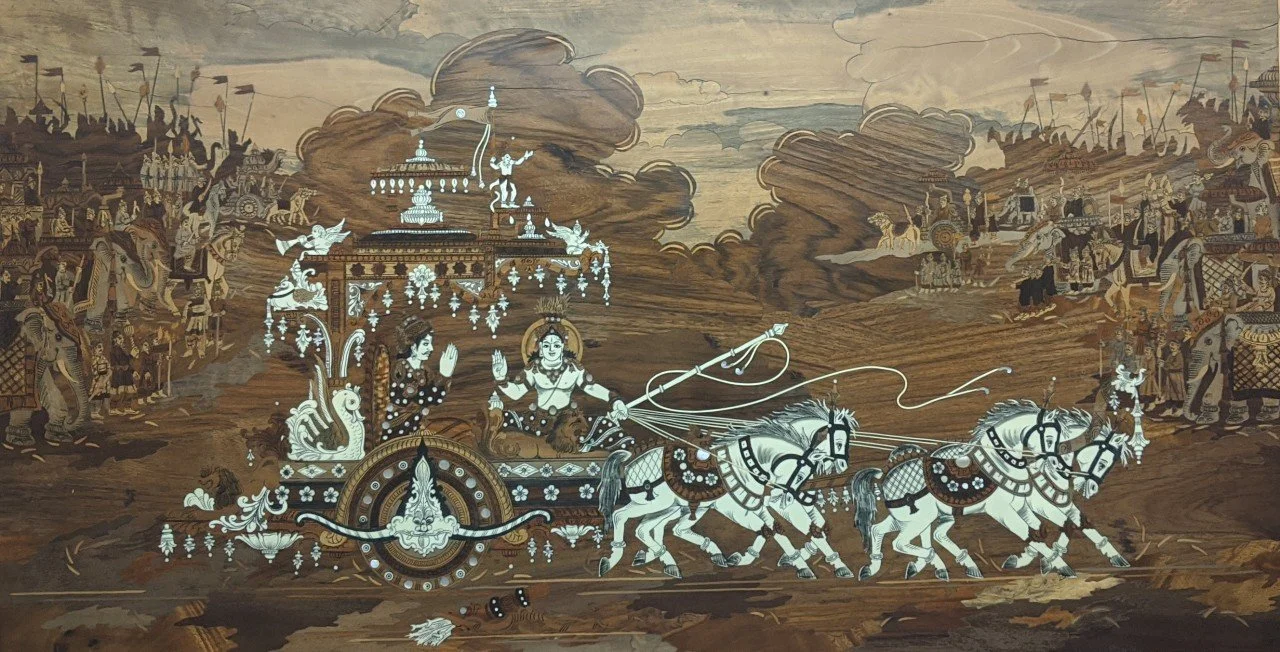
Over 7 sessions, we’ll explore all 18 chapters of the Bhagavad Gītā, one of the foundational texts of the Yoga tradition.
The Gītā is a dynamic dialogue between Arjuna (a noble warrior) and Krishna (the embodiment of awakened consciousness). Faced with an imminent battle against his own family, Arjuna is overwhelmed by doubt, fear, and confusion. Krishna offers Yoga as the path toward clarity, devotion, and self-realization.
Across 700 verses, Krishna explains why action (karma) is unavoidable, how wisdom (jñāna) dissolves ignorance, why devotion (bhakti) is the heart of Yoga, and how meditation (dhyāna) turns the mind from an enemy to a friend.
The Bhagavad Gītā is a text on how to be in relationship with duty, desire, fear, freedom, the divine, and the Self. It teaches lived philosophy, or “skill in action” (BG 2.50). One could study the Gītā for lifetimes. For now, let’s spend 10 hours together building a clear, grounded understanding of its essential teachings, and how they apply to our modern lives.
10 CEUs on Yoga Alliance for registered teachers.
Curriculum:
-
Our first session will set the foundation for the course ahead. We’ll introduce the subject matter of the Gītā including its historical and societal context. Then we’ll learn about the main characters, the family tree, and the war as a metaphor for the inner journey.
-
Chapter 1: Arjuna Visāda Yoga (Arjuna’s Despair). Arjuna expresses his fear, anxiety, uncertainty, and egoic identification. His human nature is on full display, as he desperately seeks help from Krishna, his friend and charioteer.
Chapter 2: Sānkhya Yoga (The Yoga of Discernment). Krishna responds by teaching Arjuna the foundations of Yoga Philosophy, including how to discern between the Self and the non-Self.
Chapter 3: Karma Yoga (The Yoga of Action). Krishna encourages Arjuna not to back down from action; and why “action is better than inaction” (3.8).
-
Chapter 4: Jñāna Karma Sannyāsa Yoga (Wisdom, Action, and Renunciation). Krishna teaches that action should be rooted in Jñāna (wisdom), how true renunciation is internal, and the juxtaposition of action in inaction.
Chapter 5: Karma Sannyāsa Yoga (Renunciation of Action). Arjuna asks: “You’ve praised renunciation and action. Tell me which is better?” Krishna responds that both paths are valid, but action is superior because the Yogi can cultivate renunciation within action.
Chapter 6: Dhyāna Yoga (The Yoga of Meditation). We’ll dive into the ancient practice of meditation, and discuss how Krishna’s traditional teachings can inform our modern approach to seated meditation.
-
Chapter 7: Jñāna Vijñāna Yoga (Knowledge and Realization). Krishna goes deeper into the wisdom of Yoga, including Māyā (mistaking the finite for the infinite) and how to overcome it.
Chapter 8: Aksara Brahma Yoga (The Imperishable Absolute): Krishna teaches key concepts such as Brahman, Atman, Om, and how to die according to Yoga.
Chapter 9: Rāja-Vidya Rāja-Guhya Yoga (Royal Wisdom & Royal Secrets). Krishna explains that the highest knowledge is already within us, and everyone has the potential to find it.
-
Chapter 10: Vibhūti Yoga (Divine Manifestations). Krishna shares the countless manifestations of his divine energy, and how consciousness is expressed in the world.
Chapter 11: Viśvarūpa Darśana Yoga (The Vision of the Cosmic Form). Arjuna asks to see what Krishna is describing. Krishna reveals his Viśvarūpa (universal form) in epic fashion.
Chapter 12: Bhakti Yoga (Devotion). Arjuna asks whether true devotion should be toward the unmanifest or manifest form of the divine. Krishna’s preference is the manifest.
-
Chapter 13: Kshetra Kshetrajña Vibhāga Yoga (The Field and the Knower). Krishna teaches Arjuna that his true Self is not the field itself (prakriti), but the knower of the field (purusha). With practice, the Yogi discerns between the two.
Chapter 14: Guna Traya Vibhāga Yoga (The Three Gunas). Krishna explains why awakening is hard, because we are bound to the forces of Prakriti including the 3 Gunas of Sattva, Rajas, and Tamas.
Chapter 15: Purushottama Yoga (The Supreme Being). Krishna offers the metaphor of an inverted tree; with roots above (the divine) and branches below (material creation). He teaches the difference between Kshara (perishable), Akshara (imperishable), and Purushottama (supreme being).
-
Chapter 16: Daivāsura Sampad Vibhāga Yoga (Divine and Demonic Qualities). Krishna teaches the Daivī Sampad (divine qualities) including Ahimsa and Satya, and the Āsurī Sampad (ungodly qualities) including anger and greed.
Chapter 17: Śraddhā Traya Vibhāga Yoga (The 3 Types of Faith). Krishna explains the power of Śraddhā (faith), and how a Yogi is made of their faith. He also teaches about yajña (ritual), tapas (austerity), and the mantra Om Tat Sat.
Chapter 18: Moksha Sannyāsa Yoga (Liberation through Renunciation). Krishna reiterates how liberation comes from renouncing the fruits of action rather than action itself. He closes with teachings on svadharma (purpose) and bhakti (devotion), and Arjuna expresses his gratitude.